

WRC-27 Saga – Agenda Item 1.4: Toward Harmonizing the Regulatory Framework of the 17.3–17.8 GHz Band (Ka Band) in the Space-to-Earth Direction for Global Connectivity
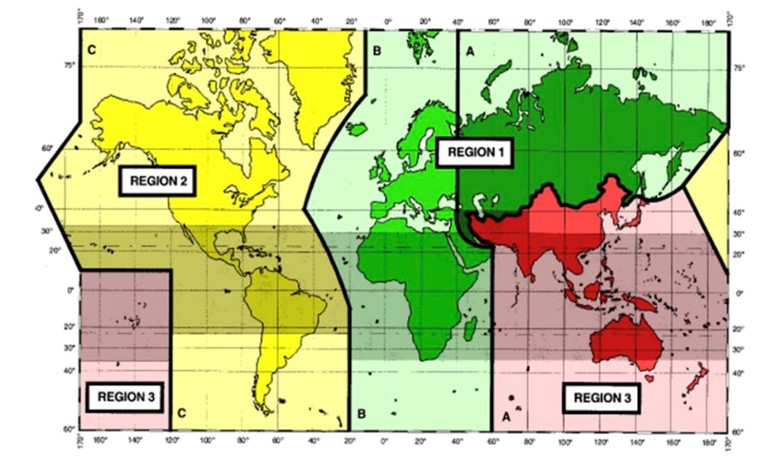
The 2023 World Radiocommunication Conference (WRC-23) enabled alignment of the conditions for using this band by the Fixed Satellite Service (FSS) in Region 2 (the Americas) with those already in place in Region 1 (Europe, Africa). At the same time, the Conference requested that the ITU study, in preparation for WRC-27, the possibility of using this band in Region 3 (Asia, Oceania).
The objective is to align the regulatory framework in Region 3 with that of the other Regions, in order to harmonize the conditions of use of this band and enable new global applications. As with any new allocation, it is also necessary to ensure the protection of existing services already operating in this band, as well as in adjacent frequency bands.
Regulatory changes under consideration
Two new uses are being considered:
- Fixed Satellite Service (FSS) (17.3–17.7 GHz) in the space-to-Earth direction: to establish links between satellites and ground stations, for example to provide broadband internet access in remote areas. Currently, the ITU Radio Regulations authorize this service in both space-to-Earth (“s-E”) and Earth-to-space (“E-s”) directions for Region 1 (Europe/Africa) and Region 2 (Americas), while in Region 3 only the E-s direction is authorized.
- Broadcasting Satellite Service (BSS) (17.3–17.8 GHz) in the space-to-Earth direction: to deliver TV or radio programs directly to users. Currently, this service is allocated only in Region 2, and not in Region 1. This issue, which corresponds to certain projects from administrations in Region 3, is therefore of more limited interest for France and Europe.
Protecting existing uses
To avoid interference with geostationary satellites, limits on equivalent power flux-density (epfd), already defined for non-geostationary satellites in Region 2 (the Americas), could be extended to Regions 1 and 3, thereby enabling global regulatory harmonization.
Among the other services to be protected are those operating in frequency bands adjacent to 17.3–17.8 GHz, as clearly identified in Resolution 726 (WRC-23). One example is the Earth exploration satellite service operating in the 17.2–17.3 GHz band, which is essential for measuring sea levels.
What are the stakes?
Harmonizing the regulatory framework for the 17.3–17.8 GHz band should improve access to internet and media services in underserved areas of Region 3, while preserving the quality of existing services.
This is particularly relevant for overseas territories such as New Caledonia and French Polynesia, which could benefit from new services provided by satellite constellations operating in this band.
Next steps and timeline
Discussions are ongoing within the ITU and European bodies (CEPT). The eighteen months leading up to WRC-27 will be crucial for finalizing and validating power limits and sharing conditions for the new FSS and BSS allocations.