

The ITU World Telecommunication Development Conference: challenges for France and ANFR
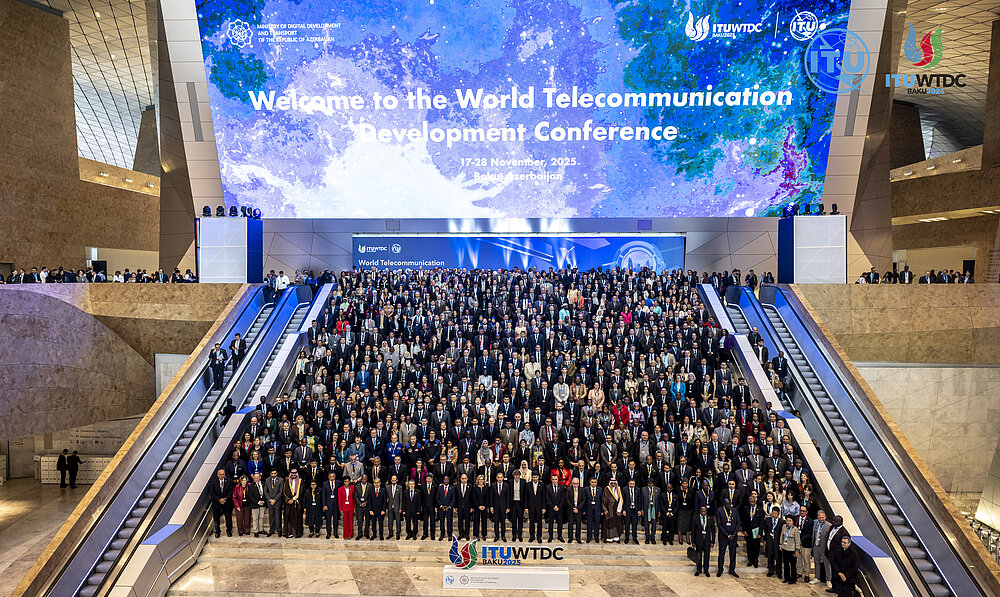
Chaired by Mr. Samaddin Asadov, Azerbaijan's Deputy Minister of Digital Development and Transport, the theme of this conference was “Universal, meaningful, and affordable connectivity for an inclusive and sustainable digital future.”
What is a WTDC?
Held every four years, the WTDC sets the priorities for the ITU Development Sector (ITU-D). The ITU-D is responsible, on behalf of the United Nations, for developing and implementing development and technical cooperation programs, in particular to reduce the digital divide.
The work focused, among other things, on:
- ITU-D's objectives and priority themes;
- ITU-D's working methods and organization;
- the adoption of a high-level policy statement and action plan.
- In practical terms, most of the discussions focused on proposals to amend existing resolutions or create new ones, put forward by the six ITU regional groups:
- the European Conference of Postal and Telecommunications Administrations (CEPT);
- the African Telecommunications Union (ATU);
- the League of Arab States;
- the Inter-American Telecommunication Commission (CITEL);
- the Asia-Pacific Telecommunity (APT);
- the Regional Communications Community (RCC).
What role for France?
As the last major ITU sectoral conference before the Plenipotentiary Conference (PP), scheduled for November 9-28, 2026, in Doha, Qatar, the WTDC is a key milestone. It provides many developing countries with a platform to express their expectations of the ITU, particularly in terms of capacity building in the field of telecommunications. The Conference also provides an opportunity to make strong symbolic statements.
Space, with the arrival of new constellations, was an important issue at the Conference. Satellite communications are essential for administrations to provide universal connectivity. However, these constellations raise questions of competition with terrestrial networks, in which investment must continue. They also raise issues of sovereignty and security due to the presence of operators from third countries.
There are significant divisions between developed and developing countries, particularly with regard to cybersecurity, artificial intelligence (AI), Internet governance, and global digital governance.
This conference also comes at a key moment for the campaigns of candidates for elected positions at the ITU, ahead of the ITU Plenipotentiary Conference scheduled for November 2026.
The French delegation was led by Ambassador Éric Fournier, who had already led a delegation to the World Telecommunication Standardization Assembly (WTSA) in Delhi in 2024. It brought together representatives from the ANFR's Directorate-General for Enterprise (DGE), the French Association for Cooperative Internet Naming (AFNIC), and Numeum, the employers' union and organization for digital professionals.
France co-chaired the WTDC Editorial Committee to ensure representation of the French language. It also chaired the ad hoc group responsible for negotiating the ITU-D Action Plan and priorities.
ANFR's action
ANFR supported European coordinators on several topics of strategic interest:
- Spectrum and IMT: several proposals to amend or delete existing resolutions on these topics had been submitted by other regions. Compromises were reached to take into account the needs of developing countries in the Union's work and activities on these specific issues.
- Space: Three draft resolutions were presented by Azerbaijan, the RCC, and the ATU. These texts reflected legitimate concerns but, on many points, went beyond the scope of the assistance that the ITU Development Sector is required to provide to Member States. They addressed issues relating to the definition and implementation of the Radio Regulations, which fall within the remit of the World Radiocommunication Conferences and the Radiocommunication Bureau. The Conference therefore gave priority to incorporating provisions relating to capacity building in developing countries for the deployment of these services, as well as the assistance expected from the Telecommunication Development Bureau, into existing resolutions.
In addition, the French delegation actively campaigned in support of Éric Fournier (ANFR) for the position of Director of the ITU Radiocommunication Bureau (BR). He is running against a German candidate, Mr. Alexander Kühn, and an Indian candidate, Ms. Revathi Mannepalli. This campaign led to in-depth discussions with nearly eighty foreign administrations about his program and his vision for the BR.